
YOLO26
Ultralytics/YOLO26
published Jan 2026 · updated Jun 2026
YOLO26 is a detection model that uses a dual-head design for native NMS-free end-to-end object detection.
specs
| Task | Object Detection |
| Architecture | YOLO26 |
| Parameters | 2.4M (YOLO26n) – 55.7M (YOLO26x) |
| License | AGPL-3.0 (Enterprise license available) |
about this model
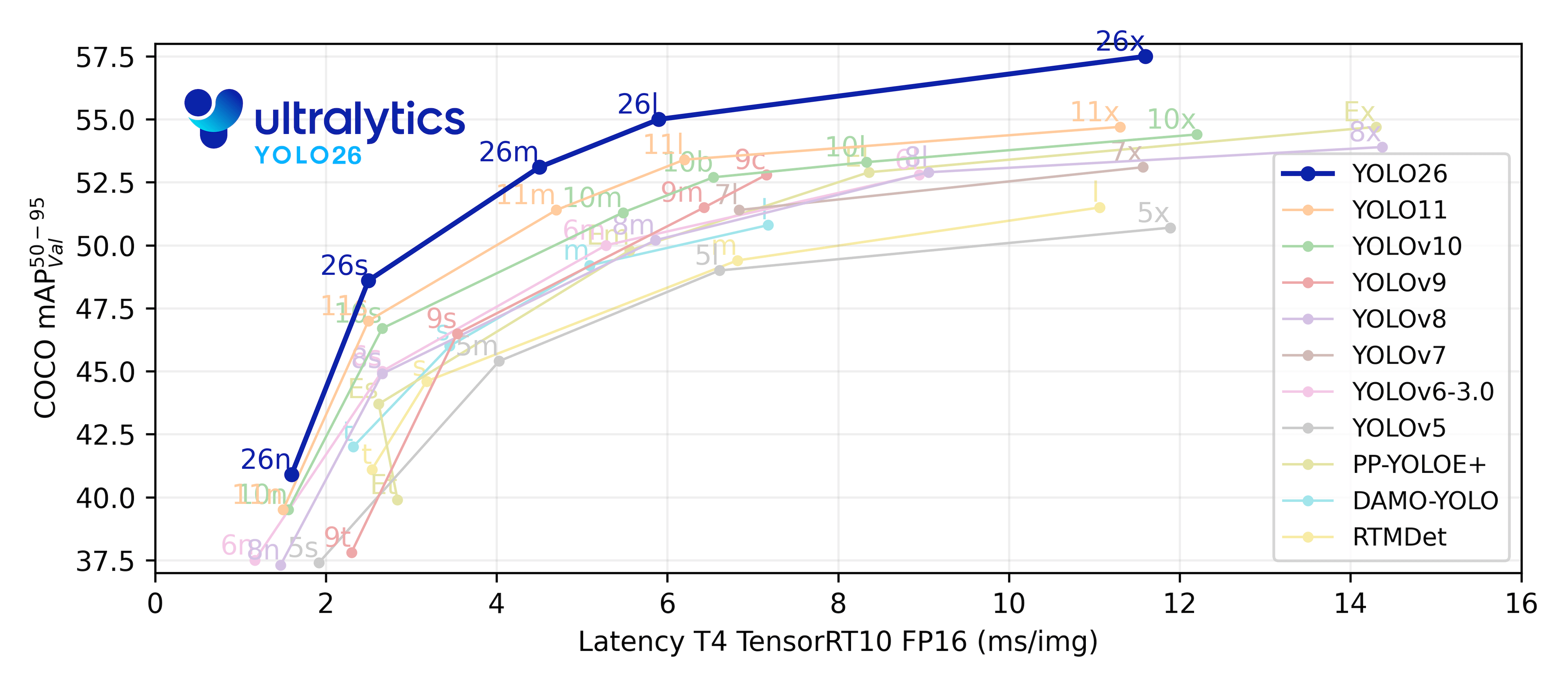
YOLO26 is a real-time object detection model that builds on the Ultralytics YOLO series with a dual-head architecture enabling native NMS-free end-to-end inference and removal of Distribution Focal Loss (DFL). It incorporates a hybrid Muon-SGD optimizer (MuSGD) adapted from LLM training, Progressive Loss, and a label assignment strategy (STAL) that guarantees positive coverage for small objects. On the COCO val2017 dataset, YOLO26 achieves the following single-model single-scale performance across five variants:
| Model | size (pixels) | mAP | mAP | Speed CPU ONNX (ms) | Speed T4 TensorRT10 (ms) | params (M) | FLOPs (B) |
|---|---|---|---|---|---|---|---|
| YOLO26n | 640 | 40.9 | 40.1 | 38.9 ± 0.7 | 1.7 ± 0.0 | 2.4 | 5.4 |
| YOLO26s | 640 | 48.6 | 47.8 | 87.2 ± 0.9 | 2.5 ± 0.0 | 9.5 | 20.7 |
| YOLO26m | 640 | 53.1 | 52.5 | 220.0 ± 1.4 | 4.7 ± 0.1 | 20.4 | 68.2 |
| YOLO26l | 640 | 55.0 | 54.4 | 286.2 ± 2.0 | 6.2 ± 0.2 | 24.8 | 86.4 |
| YOLO26x | 640 | 57.5 | 56.9 | 525.8 ± 4.0 | 11.8 ± 0.2 | 55.7 | 193.9 |
Speed metrics are averaged over COCO val images using an Amazon EC2 P4d instance. CPU speeds measured with ONNX export, GPU speeds with TensorRT. YOLO26n is up to 43% faster than YOLO11n on CPU ONNX inference (Intel Xeon CPU @ 2.00 GHz). The model is available through the Gigarouter API as a managed, OpenAI-compatible endpoint. No installation or local setup is required. For further technical details, see the official YOLO26 paper.

best for
- ·Real-time video surveillance and analytics
- ·Industrial quality inspection and defect detection
- ·Autonomous driving perception systems
FAQ
It excels at real-time object detection across 80 COCO classes, with faster CPU inference and improved accuracy over previous YOLO versions.
YOLO26 is up to 43% faster on CPU ONNX inference and achieves up to +2.5 box AP improvement on COCO detection, along with gains in segmentation and pose tasks.
It accepts images (e.g., JPEG, PNG) and outputs bounding boxes, class labels, and confidence scores in standard detection format (e.g., COCO JSON).
The model is released under AGPL-3.0 for non-commercial use. Commercial use requires an Enterprise License from Ultralytics.
Use the OpenAI-compatible endpoint with your API key, sending an image URL or base64-encoded image in a chat completion request.
We're benchmarking and onboarding YOLO26 as a hosted, OpenAI-compatible API. Sign in for free credit and be ready when it lands, or tell us you want it and we'll prioritize it.